
Shipping Seeds Internationally with forward2me
Restricted Items Guide
Seeds are one of the most regulated categories in international shipping because unlike most goods, they carry genuine biosecurity risks. A single seed packet can introduce invasive species, plant pests, or pathogens that don't exist in the destination country, which is why border authorities worldwide treat them with far more scrutiny than their size might suggest.
forward2me ships seeds from our UK, Germany, US, and Japan warehouses, but the rules vary significantly by species, quantity, and destination. Most common garden seeds fall into the restricted category which means shippable with the right conditions in place. Some require permits or certificates that can take weeks or months to obtain. And some are prohibited entirely, regardless of packaging or intent.
Before you order, this guide walks you through seed classifications, documentation requirements, destination restrictions, and everything else you need to know so there are no surprises when your shipment arrives at our warehouse.
 United Kingdom
 United States
 Germany
 Japan
Japan
Can forward2me Ship Seeds?
Overview
Seeds are among the most commonly forwarded items through forward2me. Most commercially packaged, clearly labelled seeds from reputable retailers ship without issue. However, seeds are also one of the most closely regulated categories at international borders, because some species pose genuine risks to local agriculture and ecosystems.
The three-tier classification below explains where your seeds are likely to fall. When in doubt, check with us before ordering.
Restricted and Prohibited – Which Category Applies?
Classification
Seeds for sowing fall into one of three categories. Most commercially packaged seeds from reputable retailers are in the restricted category and can be forwarded with the right conditions in place.
Generally shippable
Commercially packaged seeds
Seeds that are in original sealed manufacturer packaging, clearly labelled with species name and country of origin, and permitted under both origin and destination country regulations.
- Vegetable seeds — tomato, carrot, lettuce, pepper
- Herb seeds — basil, parsley, mint, coriander
- Flower seeds — sunflower, marigold, petunia
- Culinary / food-grade seeds — sesame, chia
Requires Documentation
Regulated or restricted seeds
Seeds that can be shipped but require additional documentation — typically a phytosanitary certificate issued by the exporting country, an import permit from the destination country, or both. Documentation must be in place before shipping.
- Seeds from rare or protected species (CITES/ESA)
- Species requiring phytosanitary certificate
- Seeds requiring treatment before entry
- Certain agricultural and field crop seeds
- Obscured seeds (coated, pelleted, embedded)
Prohibited
Seeds that cannot be shipped
Some seeds are prohibited from international shipping regardless of packaging, documentation, or intended use. Attempting to ship these may result in confiscation and disposal at customs.
- Seeds of invasive species harmful to local ecosystems
- Federal noxious weeds (US) and equivalent national lists
- NAPPRA-listed species (US) pending risk analysis
- Species banned by destination country import law
Requirements All Seed Shipments Must Meet
Conditions
 Original or commercial sealed packaging
Seeds must be in their original manufacturer packaging or commercially sealed packets. Loose, unlabelled, or home-packaged seeds are not accepted.
 Clear labelling
Each packet must show the seller's name, the scientific name of the plant, and country of origin. This is required by most destination countries and is checked at our warehouses.
.png) Destination country permits
Destination country permits
The customer is responsible for verifying what is permitted at the destination before ordering. Some countries require import permits that must be applied for weeks or months in advance.
 Free from pesticides
Seeds treated with pesticides or other coatings may require additional documentation or be subject to treatment at the port of entry.
 Securely sealed
Seeds must be sealed to prevent spillage. Damaged or open packaging will not be forwarded.
 All shipments are inspected at our warehouses
If seeds arrive that cannot legally be shipped, we will contact you. Seeds that are prohibited or lack required documentation will be safely disposed of in accordance with customs and environmental guidelines — they cannot be returned to sender in most cases.
What to Know Before Shipping Seeds
Before You Order
 Know your seed type
Seeds for sowing are regulated as plant material, not food. Even seeds that look identical – sesame, sunflower – may be classified differently depending on the retailer and packaging. A seed sold for planting and the same seed sold for eating follow different import rules.
 Seed size categories matter
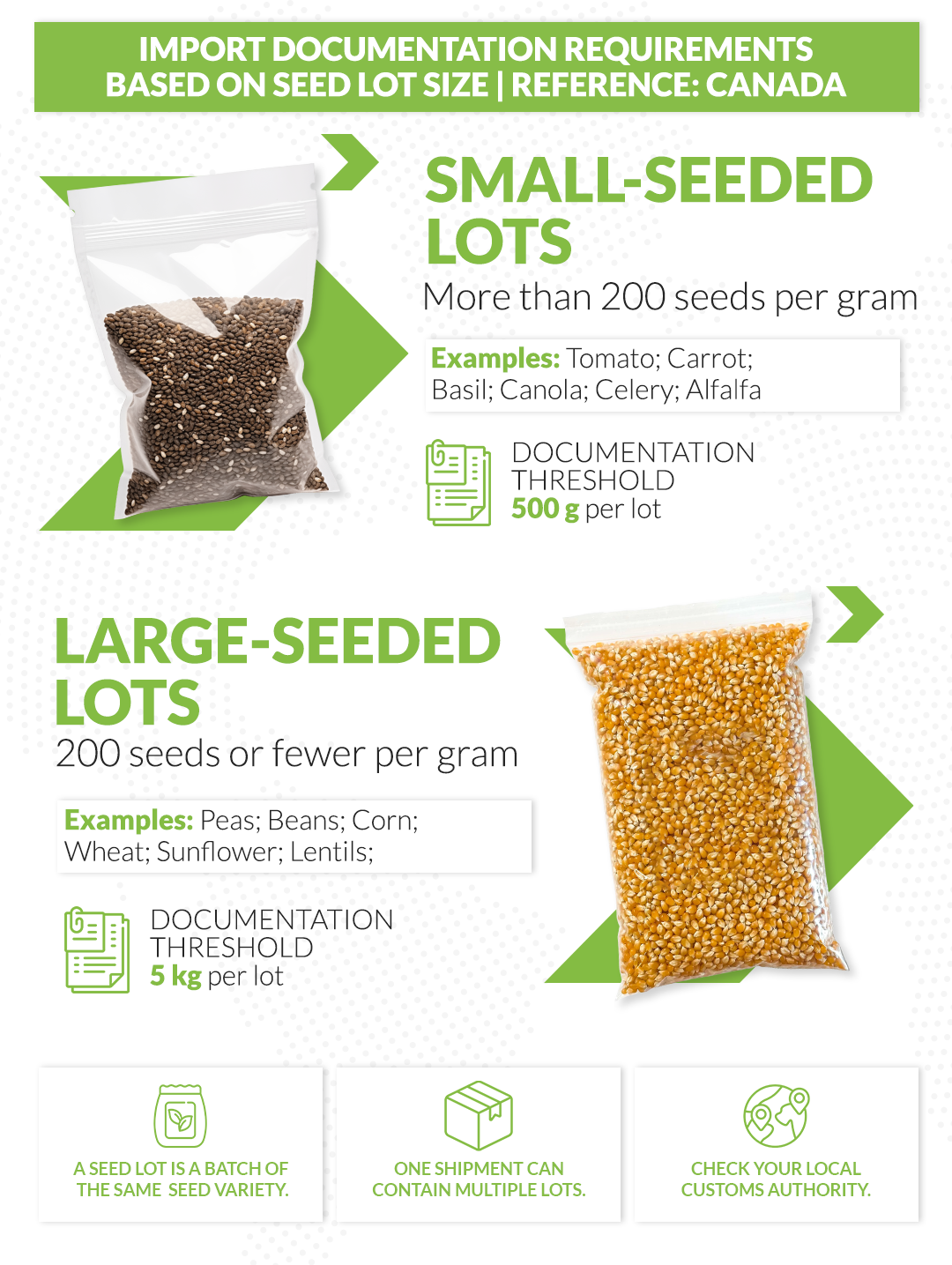
Many countries distinguish between large-seeded and small-seeded species when setting lot size thresholds and fee exemptions. Large-seeded species include peas, corn, beans, and sunflowers (≤200 seeds per gram). Small-seeded include tomato, basil, carrot, and canola (>200 seeds per gram). The same weight of seed may be treated differently depending on which category it falls into.
 Lot size affects documentation requirements
Many countries only require formal documentation above a certain weight per seed lot. Ordering small retail quantities is often simpler than bulk. Some countries set different thresholds for large-seeded vs. small-seeded species, for example, Canada requires documentation for lots over 5kg (large-seeded) or 500g (small-seeded).
 Permits can take months
If your destination requires an import permit, this must be applied for and approved before the seeds arrive at our warehouse. Processing times vary: the US can take up to 2 months, New Zealand aims for 30 business days. Do not order seeds until your permit is confirmed.
 Declare contents correctly
When seeds are forwarded, the customs declaration must include the scientific name of the species, not just "seeds" or "garden supplies." Misdeclaration, even unintentional, is a customs offence and can result in confiscation, fines, or delays affecting your entire shipment
 Check your retailer's invoice
The retailer's invoice or packing slip needs to show enough detail for customs purposes. Ideally it should include: the scientific name (genus and species) of the seeds, common name, country of origin, seed lot number or unique identifier, weight or quantity, and the seller's name and address. "Seeds" alone is not sufficient.
Understanding Seed Lots and Seed Size
Classification
When importing seeds, customs authorities don't just look at what species you're shipping — they also look at how much. The quantity per shipment is measured not just by the number of packets but by the weight of seed within each lot, and the thresholds that trigger documentation requirements differ depending on whether your seeds are large-seeded or small-seeded species.
A seed lot is a specific quantity of seed assigned a unique identifier — typically a lot number or variety name. It's not the same as a shipment. One shipment can contain multiple lots, and each lot is assessed individually against import thresholds. If you order four different seed varieties, each variety is its own lot, even if they arrive together in one parcel.
Seeds are classified by how many fit in a gram:
- Large-seeded — 200 seeds or fewer per gram. Examples: peas, beans, corn, wheat, sunflower, squash, lentils
- Small-seeded — more than 200 seeds per gram. Examples: tomato, carrot, basil, canola, celery, alfalfa
This distinction matters because many countries set different documentation thresholds for each category. Canada, for example, requires an import declaration and seed analysis certificate for large-seeded lots over 5 kg, but the threshold drops to just 500 g for small-seeded lots. A bag of basil seeds triggers paperwork at a much lower weight than a bag of peas.
Most retail seed packets from garden or specialist retailers are small — typically 1–5 g for small-seeded varieties and up to 100 g for larger ones. Single retail packets from reputable retailers almost always fall well below the thresholds that require formal documentation. Where it becomes relevant is if you're ordering in bulk — multiple packets of the same variety, larger grower quantities, or wholesale lots — in which case the cumulative weight per lot can push you into documentation territory even for an otherwise straightforward species.
Seeds for Sowing vs. Seeds for Consumption
Important Distinction
Not all seeds are treated the same way at customs. The intended use matters significantly:
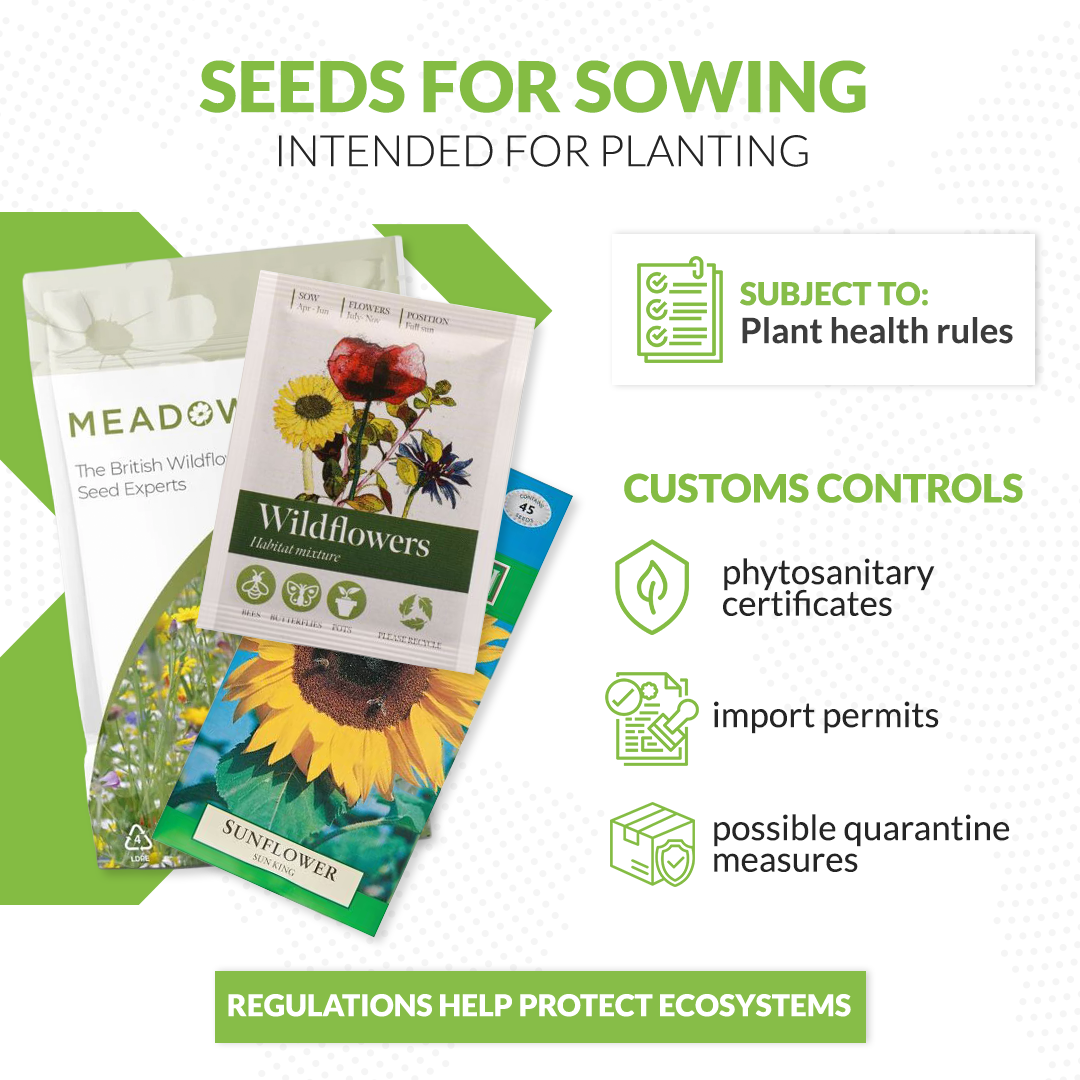
Seeds for sowing
Intended for planting — are regulated as agricultural and plant health products. They are subject to phytosanitary controls, biosecurity inspections, and in some cases import permits and post-entry quarantine. This page covers seeds for sowing.
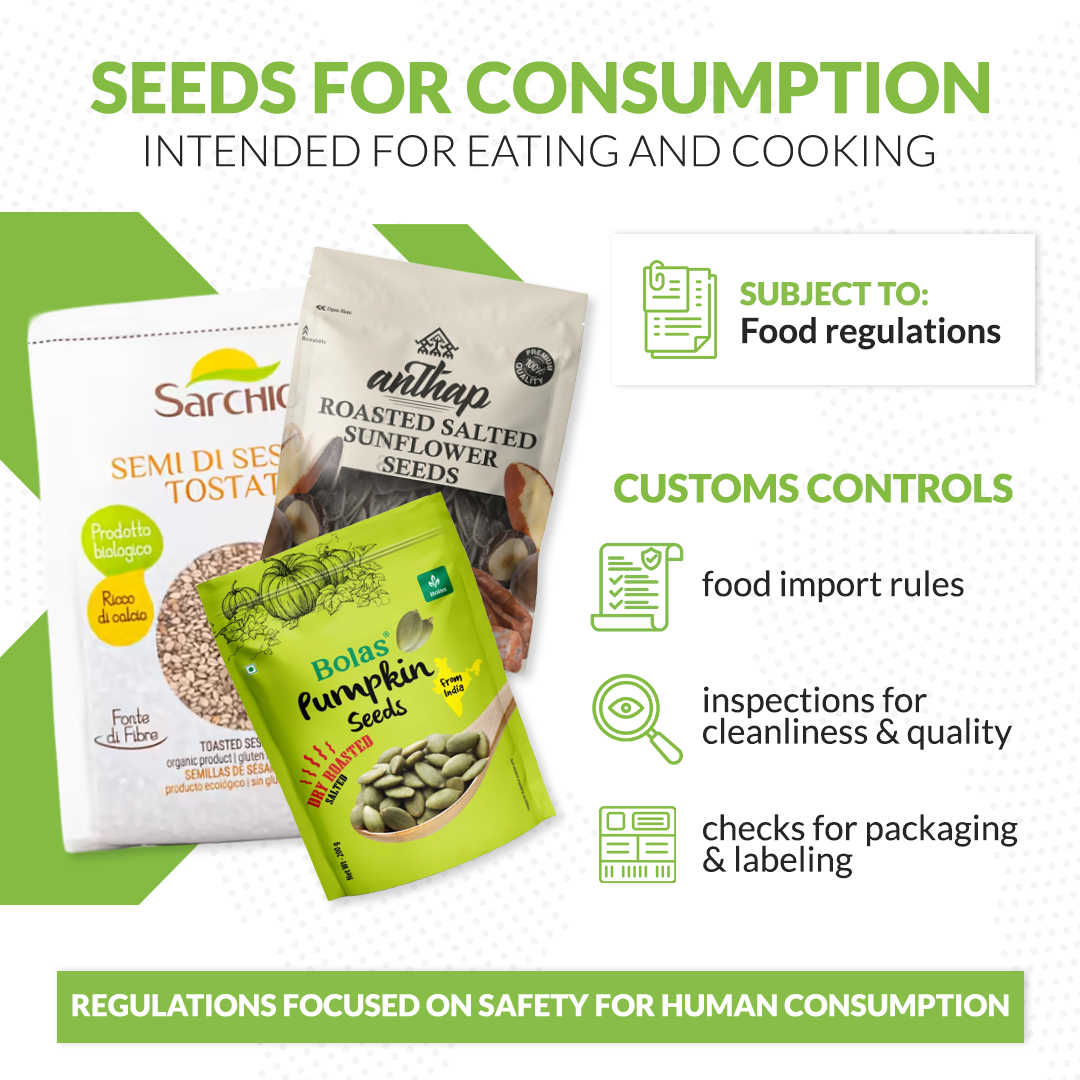
Seeds for consumption
Culinary spices, food-grade seeds, and similar products — are generally regulated as foodstuffs rather than plant material, and follow a different set of import rules. This includes items like sesame seeds, chia, poppy seeds, and cumin sold as food products.
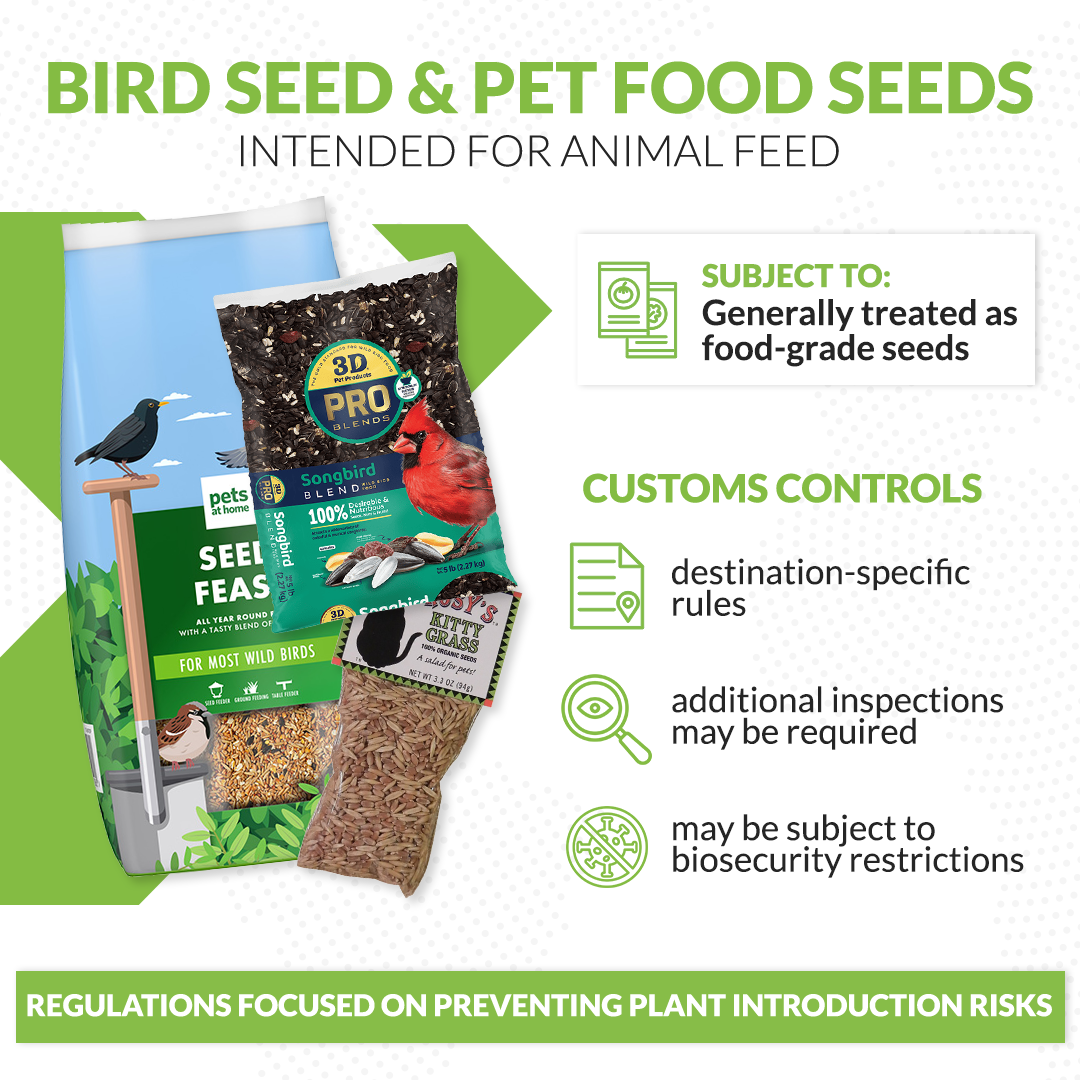
Bird seed and pet food seeds
Generally treated as foodstuffs, but destinations with strict biosecurity controls — particularly Australia and New Zealand — may apply plant health requirements if seeds are viable. Check before ordering.
Documents You May Need
Documentation
Phytosanitary Certificate
The most common document required for international seed shipments. Issued by the national plant protection organisation (NPPO) of the exporting country — not by forward2me or the buyer. It certifies that the seeds have been inspected and meet the importing country's requirements. Must be obtained before the seeds are shipped. Cannot be issued after the seeds have left the exporting country.
Import Permit
Some countries require the importer (the recipient) to apply for and obtain an import permit before the seeds are shipped. In some cases the import permit must be submitted before the exporting country can issue a phytosanitary certificate. Processing times vary significantly — allow at least 30 business days, and up to 2 months for the US. Apply through the relevant government authority in the destination country.
Certificate of Origin
Some countries require a certificate of origin in addition to other documents. This is issued by the Chamber of Commerce in the exporting country, not by the plant health authority. It can take several weeks to obtain and usually incurs a fee. Requirements vary by country and sometimes by seed species within the same country.
Seed Analysis Certificate (SAC)
Required by some countries — notably Canada — to confirm that the seed lot meets minimum purity and germination standards and is free from prohibited noxious weed seeds. Issued by an accredited seed testing laboratory. The lot number on the SAC must match the lot number on all other import documents.
Pathogen Test Results / Laboratory Report
Some destinations — particularly Australia — may require laboratory test results confirming the seeds are free from specific pests or pathogens. These are typically arranged by the exporter before shipping. If seeds have been treated with pesticides, labelling and declaration requirements apply.
Supplier's Declaration
A written statement from the exporting retailer or supplier confirming the species, origin, lot details, and compliance with applicable regulations. Required by some destinations as part of the document set presented at the border.
Documentation must be in place before seeds arrive at our warehouseforward2me does not arrange phytosanitary certificates or import permits. These must be obtained from the relevant authorities — the exporting country's NPPO for the phytosanitary certificate, and the destination country's agricultural authority for the import permit — before your seeds are dispatched to us.
Packaging and Labelling Requirements
Conditions
Regardless of species or destination, the following apply to all seed shipments.
 Original sealed packaging
Seeds must be in original manufacturer or commercial sealed packaging. Loose, unlabelled, or home-packaged seeds will not be forwarded.
 Scientific name on the label
Each packet must show the scientific name (genus and species) of the plant, seller's name, and country of origin. "Mixed seeds" or common names alone are not sufficient for customs purposes.
 Free from soil, pests, and contaminants
Packaging must be clean and free from soil, pests, and other biological material. Contaminated packaging will be refused at the border in most countries.
 Securely sealed
Seeds must be sealed to prevent spillage. Damaged or open packaging will not be forwarded.
 No pesticide treatment unless declared
Seeds treated with pesticides require specific labelling and declaration. Some destinations prohibit treated seeds entirely unless the active ingredient is registered locally.
How to Ship Seeds with forward2me
How It Works
 Confirm your seed is for sowing, not consumption
Seeds for sowing and seeds for eating follow different import rules. If you're ordering culinary seeds, bird seed, or sprouting seeds, see our foodstuffs guide. If you're ordering seeds for planting, continue below.
 Apply for any required permits before ordering
If your destination requires an import permit, apply through the relevant government authority before placing your seed order. Do not order seeds until your permit is confirmed — seeds arriving at our warehouse without required documentation cannot be forwarded.
 Arrange a phytosanitary certificate from the retailer
If your destination requires a phytosanitary certificate, contact the retailer before placing your order. The certificate is issued by the exporting country's national plant protection organisation (NPPO) and must accompany the seeds when they are dispatched. It cannot be obtained after the seeds have left the retailer.
 Ensure packaging and labelling meet requirements
Seeds must be in original sealed packaging, labelled with scientific name, seller, and country of origin. Packaging must be clean and free from soil or contaminants. Check that the retailer's invoice includes the scientific name, lot number, weight, and seller details.
 forward2me forwards your shipment
Once your seeds arrive at our warehouse with all required documentation, we'll forward your shipment. If we identify any issue, we'll contact you before proceeding. Seeds that cannot legally be shipped will be safely disposed of in accordance with environmental guidelines.
Frequently asked questions
FAQ
Seeds for sowing — intended for planting — are regulated as plant material and subject to phytosanitary controls and biosecurity inspections. Seeds for consumption — such as culinary spices, chia, sesame, and poppy sold as food — are generally regulated as foodstuffs and follow food import rules instead. The same seed can fall into either category depending on how it's sold and packaged. See our foodstuffs shipping guide for consumption seeds.
Bird seed and pet food seeds are generally treated as foodstuffs rather than plant material. However, destinations with strict biosecurity controls — particularly Australia and New Zealand — may apply plant health requirements if seeds are viable and could germinate. Check with us before ordering bird seed or pet grass for these destinations.
A phytosanitary certificate is an official document issued by the national plant protection organisation (NPPO) of the exporting country. It confirms that the seeds have been inspected and meet the importing country's requirements. You or your retailer must request it from the NPPO before the seeds are dispatched — it cannot be issued after the seeds have left the exporting country. Contact your retailer to arrange this before placing your order.
Yes — many countries set documentation thresholds based on lot weight, and these differ by seed size category. Large-seeded species (peas, corn, beans, sunflowers — 200 seeds or fewer per gram) and small-seeded species (tomato, basil, carrot, canola — more than 200 seeds per gram) often have different weight thresholds that trigger documentation requirements. Ordering small retail quantities is generally simpler than bulk lots.
If seeds arrive that cannot legally be forwarded — due to missing documentation, prohibited species, or destination restrictions — we will contact you. In most cases, prohibited or undocumented seeds cannot be returned and will be safely disposed of in accordance with customs and environmental guidelines. This is why it's essential to arrange all documentation before ordering.
Coated and pelleted seeds — sometimes called "obscured seeds" — have stricter requirements in many countries because they cannot be fully inspected visually. For US shipments, they require a separate obscured seed permit and a phytosanitary certificate. For other destinations, check requirements before ordering. Coated or pelleted seeds from some destinations may not be eligible for import at all.
Not sure if your seeds can be shipped?
Get a quote before you order — or sign up for a free forward2me address and start shopping from UK or German retailers.